First published in German, January. 17. 2003
by J. Peter Apel

Revised July, 13, 2004
Translated May, 8, 2008

The physically aerodynamic Base Formula

The mathematical derivative of the base formula for the quantity of the aerodynamic lift. In compliance with the physical rules of Newton it is only possible to generate a dynamic force by acceleration of mass. The result is that a wing has to move mass.
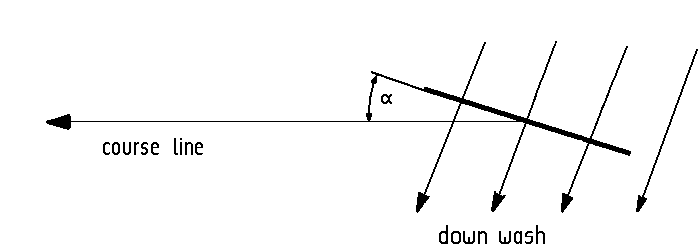
This process equals the principle of a rocket: Acceleration of mass to attain the thrust from the backstroke that is created when mass is accelerated. The wing pushes the mass of air downwards. This occurs crosswise to the surface of the wing with the principle of the slanted plane on the upper and the bottom side! The slanted plane is attained by positioning of the plane with the angle of attack, α, in relation to the course line. This phenomenon generates pressure on the bottom side and pulls or vacuum on the upper side. The herby created singular flows on upper and bottom side that run perpendicular to the plane unite after the plane and generate a continuous flow, a down stream flow or down wash. This has an effective reach for the airplane at the size of the wing span for top and bottom.

The calculation for this lift-force results from the Newton law for forces by constant velocity:

L = m dt · Vvertical down wash

The flow of masses m in kg/sec in the movement area of the moved area has to be determined. In aviation the flow of masses is the mass of air per second that is accelerated by the wing in a downward direction: the down wash. The area that is exposed to the acceleration of masses of air is: With wing span x (times) distance that is covered by the airplane per second. It is defined as Sair:


Sair = span · Vplane . . . . . Dimension m2
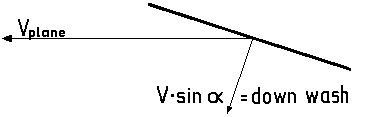
The fact that the generated flow deviates in the angle of attack, α, perpendicularly in relation to the course line has an impact on the effective area of discharge flow-through. Where the air is flowing perpendicular to area of discharge flow-through it is lowered by the factor Cosinus α.

The accorded velocity for the down wash Vdown wash results from the following drawing with V · sin α.

The flow of masses per second perpendicular to the plane results with ρair as the specific mass of air:

m dt = ρair · Sair · Vplane · cos α · sin α

The basic-formula for forces is:

Total Aerodynamic Force (TAF) = m dt · Vdown wash

The formula for the total aerodynamical force is:

_________________________________________
TAF = ρair · Sair · (Vdifferent between plane and air)2 · (sin α)2 · cos α
_________________________________________

Lift is the force in the vertically to the earthground:


The flight-formula for lift by stationary horizontal flight is:

L = ρair · Sair · (Vdifferent between plane and air)2 · (sin α)2 · (cos α)2


Forces emerge in the air only according to the Newton Laws and are airflows that are generated by planes. There is no other possibility to generate dynamic forces. This is also effective when a „stream“ collides with a solid plane: the plane generates identical airflows, exactly the same way the plane would move in the air. Only the perspective is different. For example: the rotor blades of a windmill generate the same down wash in/against the blowing wind like the wings of a glider generate down wash in/against the vertically thermal „wind“.

The relative event between a plane and air is the same in all cases.

These formulas results only by new thinking, without any historical knowledges or experiments.

flugtheorie.de